
In every manufacturing plant, maintenance decisions define productivity, cost control, and the overall health of machinery. Many factories still operate in a “break-fix” style of maintenance, but industry leaders increasingly rely on lubricant data to prevent failures before they happen.
Preventive vs. reactive maintenance is not just a choice in strategy; it reflects how well a plant understands the signals its machinery gives through lubrication condition.
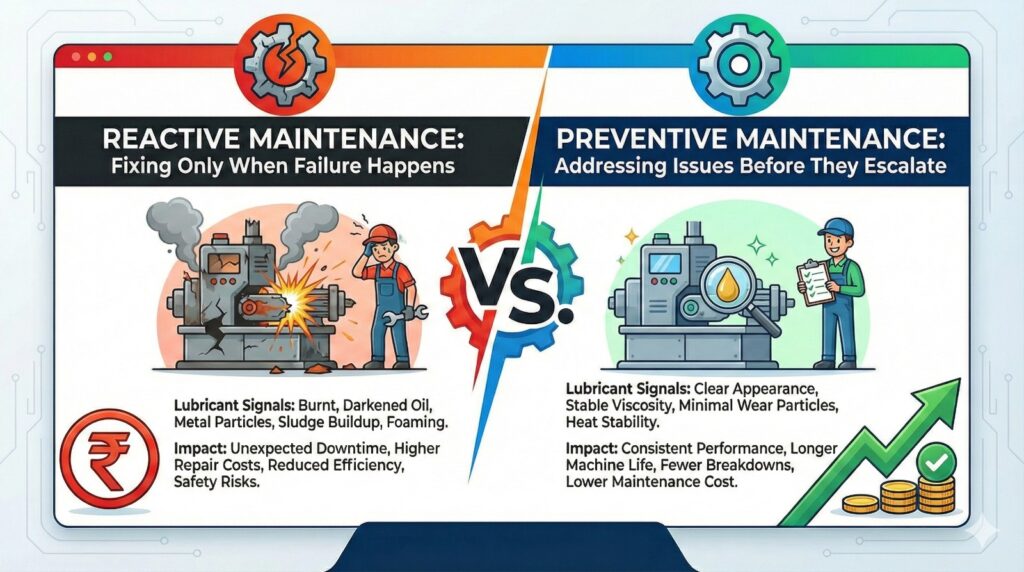
1. Reactive Maintenance: Fixing Only When Failure Happens
Reactive maintenance allows machines to run until they fail. Repairs only occur after a breakdown, causing sudden disruptions and costly downtime.
What Lubricants Reveal in Reactive Maintenance:
- Burnt or darkened oil indicating overheating
- Metal particles indicating severe wear already underway
- Sludge buildup showing oxidation and lubricant breakdown
- Foaming or water contamination suggesting seal failure or poor storage
When these signs appear, the damage is usually already extensive.
Impact on Operations:
- Unexpected downtime
- Higher repair and replacement costs
- Reduced machine efficiency
- Increased energy usage
- Frequent safety risks and operational uncertainty
Reactive maintenance is unpredictable, expensive, and unsustainable for modern manufacturing.
2. Preventive Maintenance: Addressing Issues Before They Escalate
Preventive maintenance follows scheduled care routines, inspections, lubrication planning, and early diagnostics.
What Lubricants Reveal in Preventive Maintenance:
- Clear appearance and stable viscosity indicating healthy operation
- Minimal wear particles showing controlled friction
- No dust or water contamination, meaning proper sealing and storage
- Heat stability indicating correct lubricant selection
In preventive systems, lubricants actively signal early warnings, allowing teams to intervene before failures occur.
Impact on Operations:
- Consistent, reliable performance
- Longer machine and component life
- Fewer breakdowns
- Lower overall maintenance cost
- Higher output and safer working conditions
Preventive maintenance enables a plant to control outcomes rather than react to them.
3. How Yeskolube Lubricants Support Preventive Maintenance
The right lubricant is not only a protective medium; it is a diagnostic tool that helps engineering teams predict equipment health.
Yeskolube’s industrial lubricants are engineered to provide:
- High-temperature stability to prevent thermal breakdown
- Anti-wear and anti-oxidation additives that protect equipment
- Clean-running formulations that highlight contamination early
- Longer lubricant life for reduced maintenance frequency
- Reliable film strength under extreme load and temperature cycles
This combination allows factories to detect issues early and plan maintenance intelligently.
4. The Shift Toward Reliability-Based Operations
Plants that continue relying on reactive maintenance struggle with avoidable losses.
Plants that embrace preventive maintenance build a culture of reliability.
Lubricants offer some of the earliest indicators of machine health. Analyzing oil and grease condition helps teams:
- Detect abnormal wear
- Predict potential failures
- Plan maintenance without disrupting production
- Reduce operational risk and downtime
The result is a plant that operates with confidence and long-term efficiency.
Final Thought
Machines always communicate their condition — and lubricants are often the first to reveal the truth.
Understanding these signs is the key to preventing failure and improving performance.
Yeskolube — Your Problem, Our Formula.